Undergraduate
Research
During my Undergraduate Studies I had the wonderful oppurtunity to work under Dr. Qi Zhong.
In my time working with Dr. Zhong, I was able to work with very real projects.
Working on photonics and electronics projects is truly amazing, and the hands on and technical work that pushed me to learn more about electrical engineering and physics was incredibly rewarding
and one of the highlights of my time at Michigan Tech.
The bulk of my time working with Dr. Zhong was spent working with Non-hermitian systems. A field of study in quantum physics where the Hamiltonians of a system
are non-hermition, giving the field it's name. Non-hermitian systems mean the Hamiltonian of the system is not equal to it's adjoint, and often lead to complex eigenvalues. These complex eigenvalues
typically imply that these systems express gain or loss.
It's these gains and losses that are most intruguing and the systems around them are what I worked with, attempting to design such systems and observe these non-hermitian properties.
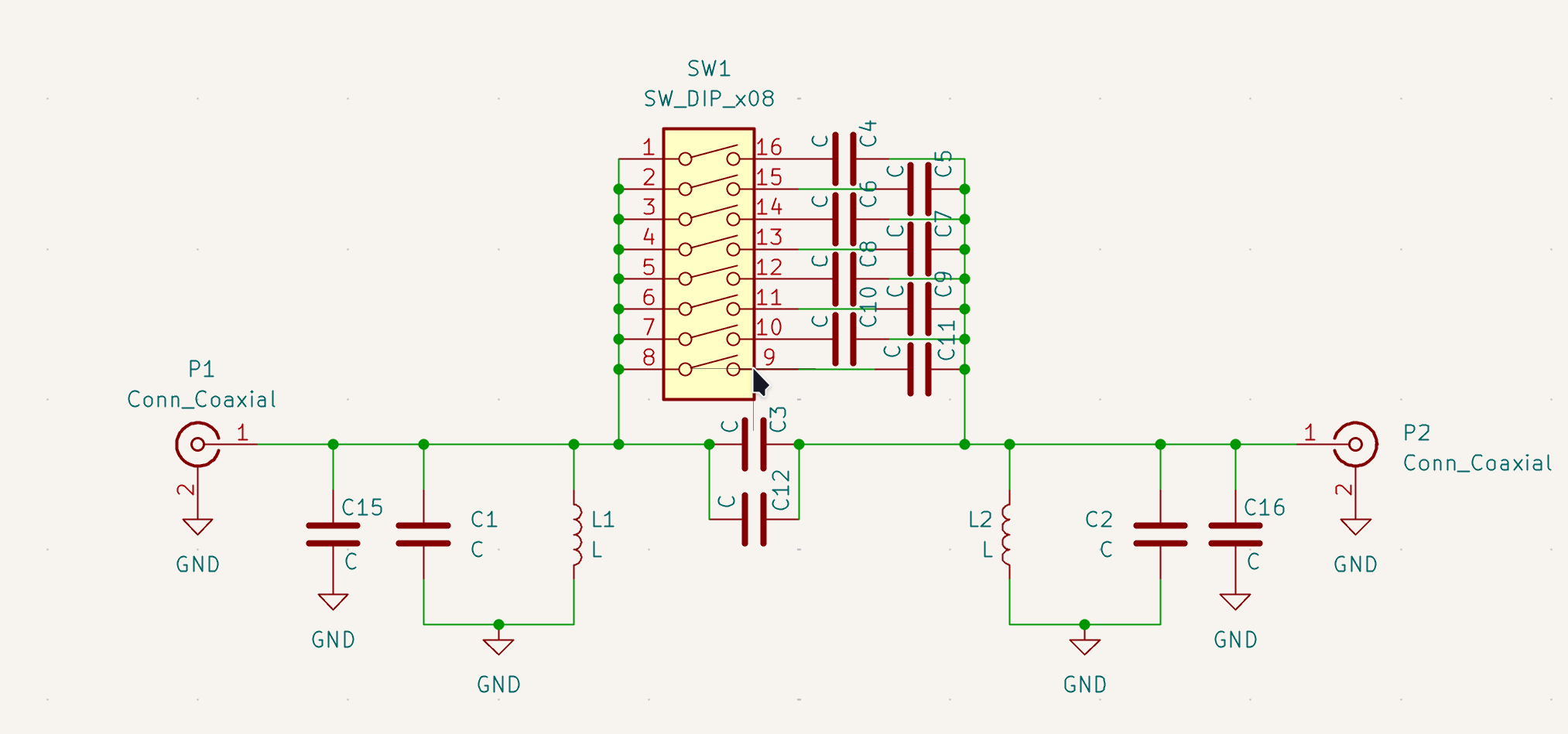
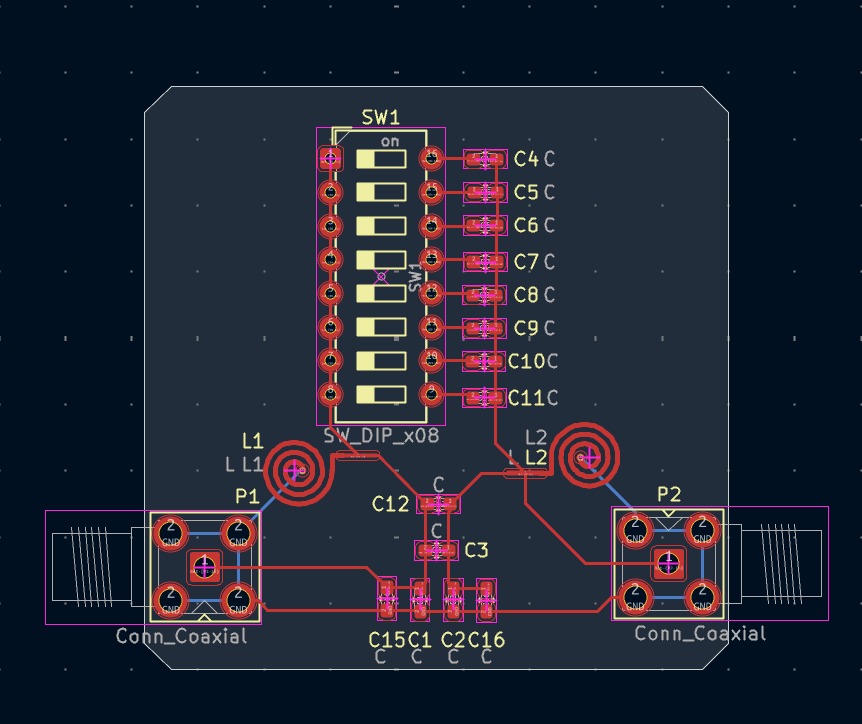
One of these such systems is an electrical resonator circuit. Comprised of 2 LRC resonators coupled with a capacitor, the circuit seeks to replicate the strong gain/amplification characteristic of non-hermitian systems. Initially simulated using LT-SPICE to observe the gain of the circuit at different frequencies, and test different values of coupling capacitance. The schematic was then designed in KiCAD and then a PCB derived from the schematic. The design accomodates an 8-way DIP switch in order to observe these effects across a multitude of coupling capacitances.

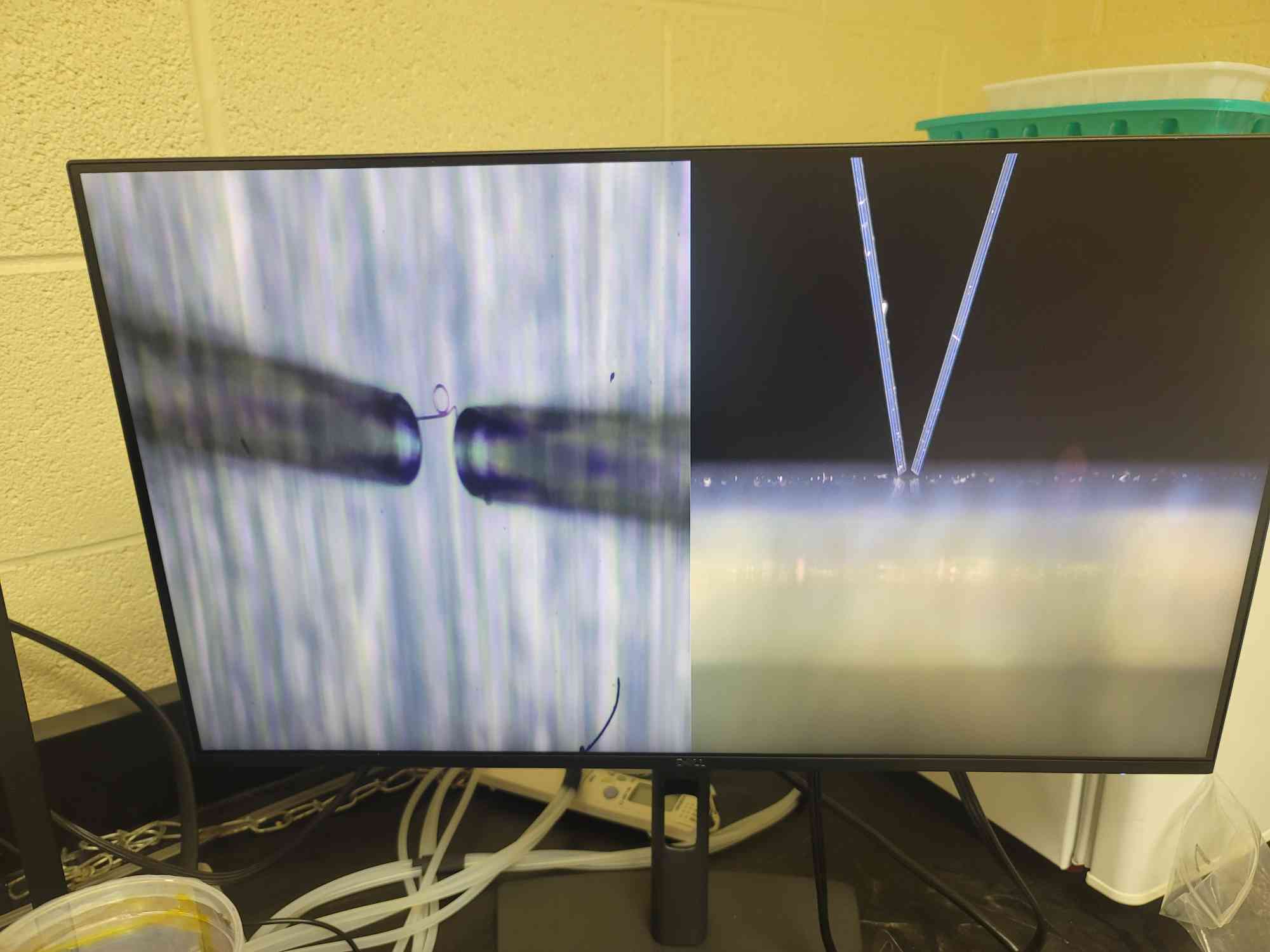
Another both use and system of non-hermitian physics is microring resonators. Pictured above is a lone resonator. Additional work I conducted involved the design of such structures for use in integrated photonics, where the samples were constructed by a collaborator. These microrings serve as a photonic analog to the electrical LRC resonators above.