AutoDrive
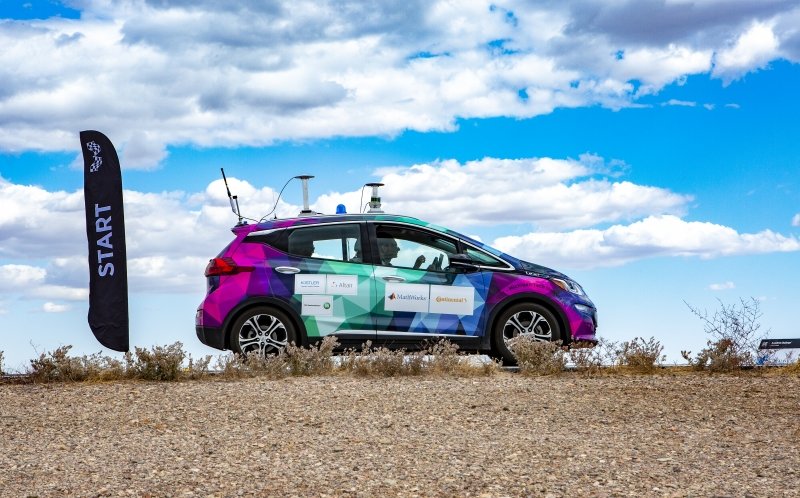
As a member of Michigan Tech's Robotic Systems Enterprise I had the amazing oppurtunity to work on the AutoDrive II challenge. A 5 year competition between 10 different teams including Prometheus Borealis, the team representing Michigan Technological University. The AutoDrive challenge tasked the different teams with the creation of a Level 4 autonomous vehicle through modification of a provided Chevy Bolt.
Perception
AutoDrive development was seperated into multiple different subteams. Of these were Controls, Mathworks, Project Management, Mapping & Planning, and Perception. I spent the duration of my time on AutoDrive with the Perception Subteam. The bulk of our efforts were focused on the localization system, utilizing a Simultaneous Localization and Mapping (SLAM) algorithm built largelely off of the notion of using identifiable landmarks such as light poles/fixtures to map the cars relative position.
Newton's Method
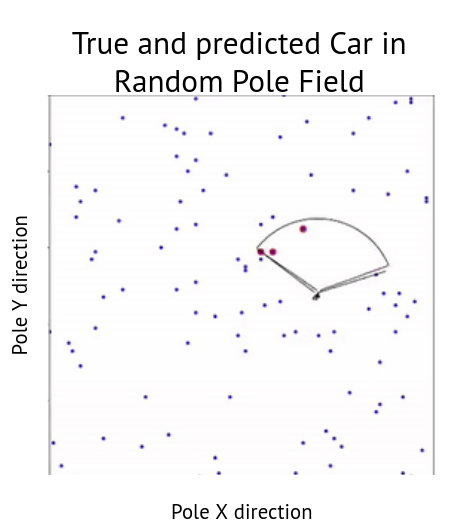
Newton's method is what the Perception subteam decided to name our localization method. Utilizing the aforementioned light poles, the Newton's method sought to utilize identified and associated poles Our localization approach utilized the mathematical process by the same name to iteratively determine a closer and closer approximation for the cars position through a linear approximation of the car and light pole system and that systems changing in time.
$$Pos=min||A \underline{x_{c}^w}[t]-b||$$ $$e(\underline{x_{c}^w}+\Delta\underline{x_{c}^w})-e(\underline{x_{c}^w})=e'(\underline{x_{c}^w})*\Delta\underline{x_{c}^w}$$